
Specify folding cartons using the required inside dimensions, a stated unit and a drawing that identifies the opening and front panel. Measure the complete product configuration first, then agree space for packing, inserts and removal. Confirm the final fit on a structural sample before approving artwork.
A number such as “50 × 35 × 120” leaves several decisions unanswered: which way the carton opens, whether those dimensions describe the product or the box, and whether the unit is millimeters. This guide turns measurements into a usable brief for custom folding cartons.
- Separate product dimensions, required inside space and outside shipping dimensions.
- State the unit and mark each dimension on an oriented drawing.
- Account for caps, inserts and other components in the packed configuration.
- Agree clearance and manufacturing tolerance separately, then check a sample.
1. Measure the product as it will be packed
Begin with the complete pack contents. Include the cap, pump, accessory, leaflet and any protective component that will occupy the carton. Identify whether the product is packed upright, on its side, assembled or partly assembled.
MOD-PAC’s folding-carton measurement guide calls out product variations, assembly, orientation and additional packaging as decisions to establish before sizing. These details explain why a nominal bottle capacity or a product photograph cannot determine the box dimensions.
Use a ruler or caliper appropriate to the part, without compressing flexible features. Record the widest points and any protrusions. If several variants share one carton, list the variants and supply representative samples instead of assuming one measurement covers them all.
2. Keep inside and outside dimensions separate
Inside dimensions describe the space available for the product; outside dimensions describe the assembled pack’s exterior. Board thickness and construction affect the relationship between them. MOD-PAC recommends internal measurements when determining folding-carton fit.
| Record | Use it for | Include in the brief |
|---|---|---|
| Product envelope | Understanding the full contents and their packed orientation. | Maximum measured extents, protrusions, accessories and variant notes. |
| Carton inside dimensions | Designing the usable fit and room for inserts or packing access. | Target dimensions, units, opening direction and fit requirements. |
| Assembled outside dimensions | Checking shelf space, an outer shipper or another constrained space. | Any external limit and the assembled configuration to be measured. |
Packlane’s sizing guidance likewise separates inside dimensions from estimated outside dimensions and notes that material thickness varies. Its published allowances and tolerances describe its products; they should not be copied into a custom MEIKEI carton specification.
If you are replacing an existing box, send the physical sample or a clearly photographed measurement record. A ruler placed across the outside gives an outside dimension, even if the old quotation used inside dimensions. Label the record according to what you actually measured.
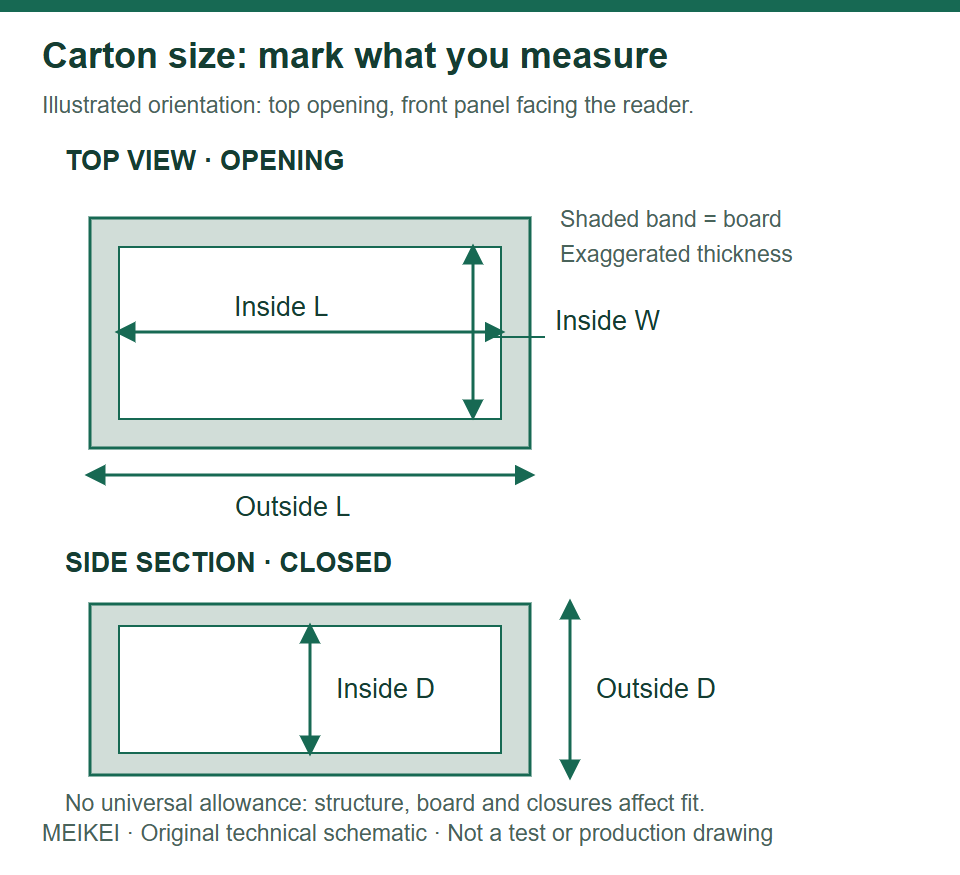
3. Mark the opening and dimension order
Use a dimensioned sketch to remove ambiguity from length, width and depth. Mark the face the customer sees, the opening direction and the three perpendicular measurements. Then use the same names in the drawing, quotation and structural approval.
Packlane’s sizing guidance defines length side to side, width front to back and depth top to bottom. Our diagram uses a top-opening orientation to make those three axes explicit. Confirm the drawing orientation with your supplier rather than relying on the abbreviations alone.
For a straight tuck end carton, show the intended front and how the top flap opens. If a product must face a window or sit in a particular direction, add that requirement to the sketch. The carton can have the right numerical volume and still present the product incorrectly.
If the end closure is still undecided, compare straight tuck and reverse tuck end boxes before approving the drawing. Mark the front face and both opening directions alongside the internal dimensions.
4. Agree clearance and tolerance separately
Clearance is the space intentionally allowed for fit and handling. Manufacturing tolerance is the agreed permitted variation in the finished measurement. Increasing a dimension to help packing does not define how much production variation the buyer will accept.
Ask the structural reviewer to propose a fit around the actual product, chosen board and any insert. Describe how the pack will be assembled and how the customer removes the contents. There is no single extra number to add to every bottle, bar, tube or kit.
As an illustrative brief, a buyer might report a measured product envelope of 40 × 30 × 110 mm and request a carton with an insert. Those numbers describe only the product. They are not a recommended carton size: the insert, closure and handling requirements still need review. Keep the proposed inside dimensions in a separate field so that the product measurements cannot be mistaken for an approved box specification.
5. Check the structural sample before placing artwork
Pack and open the proposed structure with the intended contents. Review insertion, closure, product movement and removal. Note whether a leaflet or insert changes the fit. Record the approved dimensioned drawing and sample revision together.
- Place all components in their intended orientation.
- Close the carton and inspect the tuck engagement, panel shape and visible fit.
- Open it using the intended access point and remove the contents.
- Record any difficult packing step, unwanted movement or contact with fragile features.
- Confirm the revised structure before building artwork on its dieline.
A structural sample answers fit questions; it does not establish printed color or the protection of the complete shipping pack. Use the sample approval checklist to record those as separate checks, and the artwork handover guide after the structure is approved.
Send a complete carton measurement record
Include your product measurements and units, filled weight, component list, orientation sketch, insert requirements and any outside-size limit. State the quantity for each artwork version and the delivery country. Identify measurements as “observed,” “proposed” or “approved” so their status is clear.
MEIKEI’s folding-carton MOQ is 100 boxes. You can upload a dimensioned sketch and product photographs with a straight tuck end box specification, or use the project inquiry form if the structure is still undecided. A supplier can review an incomplete brief more usefully when the unresolved dimensions are explicitly identified.
Example: a complete measurement brief before sampling
A complete brief records the known values and explicitly leaves unapproved dimensions open. The example below is a fictional planning exercise, not a shipped order or a tested carton. The product measurements are not the carton dimensions.
| Field | Example entry |
|---|---|
| Product envelope | 40 × 30 × 110 mm, including the cap; packed upright. Example measured values, not a standard size. |
| Contents | One capped product and one folded leaflet; combined example weight 150 g. |
| Orientation and structure | Top-opening folding carton; front panel marked on sketch. Supplier to propose tuck style and whether an insert is needed. |
| Required inside dimensions | To be proposed after reviewing the product and leaflet samples; no inside size approved. |
| External constraint | No shelf or shipper limit supplied. Confirm before releasing the structure. |
| Board, clearance and tolerance | To be agreed separately on the structural drawing; no default allowance specified. |
| Quantity and destination | 100 cartons, one artwork version; example destination: United States. |
| Approval record | Sample fit, closure, removal and artwork dieline revision pending buyer approval. |
Send front, side and top photographs with a ruler when a physical sample is not yet available. Keep the product outline and assembled carton measurements in separate images. The supplied carton cover photograph is a product reference; it does not show a verified product-to-box fit.
Questions about folding-carton sizing
Can I use dimensions measured from a flattened carton?
A flat sample can help the structural reviewer identify panels, folds and closures. Send the physical sample and ask the supplier to confirm the assembled inside dimensions on a dimensioned drawing. Do not use the full flat sheet’s width and height as the assembled inside dimensions.
Is the longest dimension always the length?
Do not assume that across every supplier’s naming convention. Show the opening and label all three axes on a drawing, then confirm the order used in the quotation.
Should I send inches or millimeters?
Either can be communicated if the unit is explicit and the agreed drawing uses it consistently. Avoid mixing unlabeled values from different tools. Confirm the final production drawing rather than repeatedly rounding between units.
Published by MEIKEI Printing as general packaging planning guidance. Material suitability, product performance and production details must be confirmed for your actual specification. Linked technical references support the relevant points; illustrations are not test evidence.