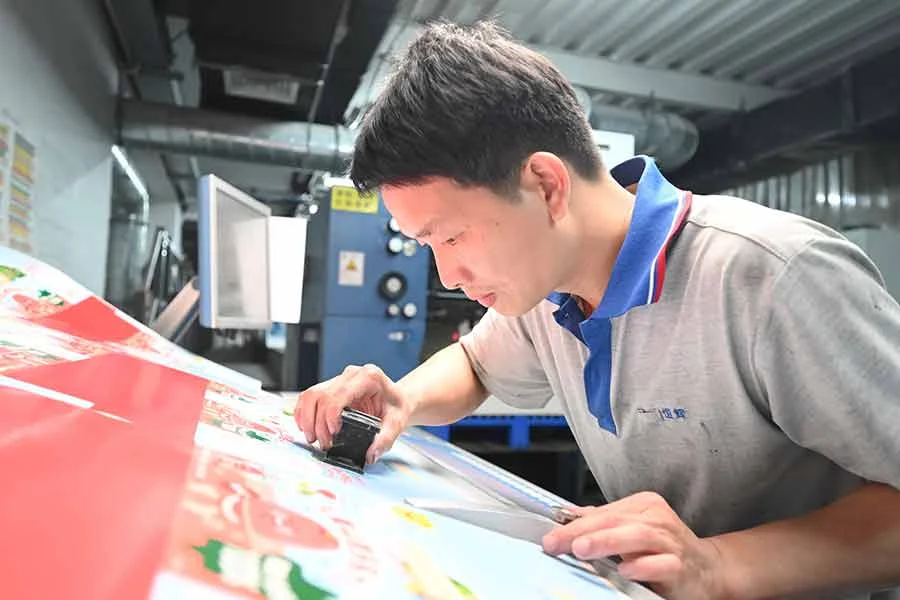
Window patching adds a transparent film behind a cut opening in a folding carton. The visible opening, the larger film patch and the adhesive area are three different features. Defining only the opening leaves the supplier to guess how the window should be attached and how the carton should fold.
For buyers, the first decision is what the window must reveal: a product colour, a particular finish, a count of items or the actual product shape. That viewing requirement should guide the structure before decorative artwork is approved. This guide focuses on window design for custom folding cartons, rather than general carton dimensions or printing effects.
Key takeaways
– Draw the viewing opening and the film-patch boundary separately.
– Confirm clearance to folds and glue areas with the converter; there is no single allowance that suits every production route.
– Approve a sample with the proposed film attached and the real product packed inside.
– A transparent window does not automatically establish moisture protection, food-contact suitability or recyclability.
What happens during window patching?
The carton blank receives a cut opening, and a film patch is attached over that opening. Pro Carton’s folding-carton manufacturing guide explains that the window is cut at the cutting-and-creasing stage and film is subsequently applied using windowing equipment.
The opening is the part the customer sees through. The patch extends beyond it so there is board available for attachment. A plain cutout without film is a different specification and should be described as an open window.
This distinction affects approval. A white carton mockup with a hole can demonstrate the view, but it cannot demonstrate the appearance, attachment or folding behaviour of the finished film patch.
What should the window actually show?
Specify a viewing target before selecting an aperture shape. “Show the embossed surface on the front item” is more useful than “add a large window.”
Check that the product remains aligned with the opening after packing. If a jar can turn, a window intended to display its label may instead show the label seam. If several items can move independently, a larger opening may reveal packing gaps rather than improve presentation.
Use the product, insert and carton as one approval assembly. Mark the acceptable visible area on a sample photograph. If presentation requires the product to remain fixed, ask the structural designer how that will be achieved; the film itself should not be assumed to provide product restraint.
How close can a window sit to a fold?
Get a converter-approved clearance rather than using a number from a generic template. The opening, patch edge and adhesive pattern each need space in relation to a fold.
For example, trade finisher C&H Letterpress publishes approximately 1/2 inch between an opening and the nearest score for its own window-patching work. That is a useful demonstration of a production-specific rule, not a universal MEIKEI specification. Its window-patching guidance also distinguishes the opening from the larger film patch and discusses coating-free bonding areas.
Ask the designer to flag any opening that crosses a corner or approaches a closure. Moving a window after the cutting tool has been approved can affect more than the front-panel artwork. Use the dieline reading guide to identify these structural features before commenting on a proof.
Which film details belong in the specification?
Request the film identity and thickness, not just “clear plastic.” Also ask the supplier to record the optical appearance and attachment method proposed for this particular pack.
Do not choose a film by a recycling symbol or a material acronym alone. The finished carton includes board, decoration, adhesive and film, and any disposal or suitability claim needs evidence for the intended market and construction.
For the initial brief, this decision table keeps purchasing questions separate from assumptions:
| Decision | Information to request | What the sample should resolve |
|---|---|---|
| Viewing quality | Proposed film and surface appearance | Haze, reflections or distortion that obscure the intended detail |
| Patch placement | Patch boundary and permitted registration variation | Film remains behind the whole opening without visible adhesive |
| Folding | Agreed relationship to scores and closures | Erecting and closing the carton does not lift or wrinkle the patch |
| Bonding | Adhesive system and any coating exclusion | The proposed decoration is compatible with the attachment area |
| Product interaction | Intended separation between product and window | Edges or movement do not visibly damage the window during agreed handling |
| Specific-use claims | Applicable supplier documentation | Evidence matches the actual material and intended use |
There is no need to prescribe a film gauge before the product and window design are known. Ask the converter to explain the proposed choice and then evaluate that construction.
How should the artwork accommodate the patch?
Treat the attachment area as part of the production drawing. It must be reviewed alongside ink, coating, foil and glue specifications.
Netpak’s window-patching overview describes the importance of patch overlap for attachment and visual consistency. The practical buying step is to request an annotated dieline showing the proposed window system, rather than assuming the printer will infer it from a rendered image.
Avoid placing tiny text or a critical border immediately beside the cut edge without a reviewed allowance. If decoration needs precise alignment with the opening, identify that requirement explicitly on the proof. The packaging artwork checklist helps keep structural and decorative layers understandable.
What does a complete window brief look like?
The following is an illustrative enquiry, not a production recommendation or an actual customer project:
| Brief field | Example entry |
|---|---|
| Product | One sealed jar, with a physical sample supplied |
| Viewing target | Front label and visible product colour must be seen while packed |
| Window position | Front panel only; proposed opening marked on a sketch |
| Product restraint | Supplier to propose a way to keep the jar facing forward |
| Patch specification | Converter to propose film, thickness, patch boundary and adhesive |
| Decoration | Printed carton with a matte surface; bonding exclusions to be identified |
| Approval | Filled, converted sample with the proposed film and decoration |
This example deliberately leaves production allowances open for engineering review. A fully dimensioned aperture sketch is not the same as an approved window construction.
What should you inspect before approving production?
Inspect the filled carton under the lighting in which customers are likely to view it. Then inspect the empty converted sample so you can see the film edge and attachment area.
Record visible glue, patch lift, wrinkles, cloudy areas, displaced film and interference when the pack opens or closes. Identify which observations are unacceptable for this design and agree reference samples with the supplier. These are suggested inspection points, not invented industry pass/fail limits.
Keep the approved sample and final drawing together. If the film, coating or adhesive changes later, ask whether the window needs to be reapproved. Our packaging sample approval checklist provides the broader handover record.
For a quotation, send the real product dimensions, a viewing sketch, quantity and destination. MEIKEI’s folding carton starting MOQ is 100 finished cartons; window construction and production feasibility need review for the specific order. Request a window-carton review with the feature you want customers to see.