Water-resistant labels are intended for limited moisture exposure; waterproof labels are intended for more demanding wet use. The useful buying question is what the finished, printed label must survive on your actual container. A label that tolerates a splash on a bathroom shelf may still fail in an ice bucket, under repeated rubbing or when applied to a wet bottle.
For beverage, personal-care and household-product buyers, start with three details: the exposure, the container and the application conditions. Then compare samples made with the proposed face material, print, protective finish and adhesive together.
What is the difference between waterproof and water-resistant labels?
Avery’s terminology guide distinguishes occasional splashes and condensation from prolonged water contact or submersion. Use that distinction to describe your requirement, then ask the supplier which conditions its claim actually covers. The word “waterproof” alone does not tell you the duration, temperature or condition of the tested sample.
The following is a purchasing guide: each row identifies a question to resolve with samples, rather than a performance guarantee for a material.
| Product use | Describe this in the brief | What to check on the labeled container |
|---|---|---|
| Dry shelf, occasional wet hands | Splash frequency and handling | Print smearing, abrasion and edge lift |
| Chilled drink brought into a warm room | Condensation and wet/dry cycles | Adhesion, wrinkles and appearance while wet |
| Beverage stored in an ice bucket | Water temperature and immersion duration | Edge lift, print legibility and adhesive whitening |
| Shampoo or shower product | Repeated wetting, handling and product spills | Print wear, lifting and residue after use |
| Reusable container washed repeatedly | Wash method, detergent and temperature | A separately agreed washing requirement |
A dishwasher requirement needs its own evidence. So do resistance to alcohol, oil, sunlight or cleaning chemicals. A water-resistance claim does not establish those other properties.
Why does the whole label construction matter?
Treat the label as a system, rather than choosing only a face material. Ask for the proposed specification in writing:
- Face material: the paper or film carrying the print, including any coating.
- Print system: the ink and print process used for the order.
- Surface protection: the proposed varnish or laminate, if any.
- Adhesive: the exact grade or an agreed performance specification for your container and use.
Your bottle or jar is the other half of this system. Identify whether it is glass, PET, HDPE or another material; provide the actual container where possible. A supplier’s sample on a different bottle is useful for appearance, but it does not resolve your application.
For the material-selection step, see our BOPP vs paper label guide. Here, the decision is whether the proposed finished construction meets a wet-use requirement.
Can the same label material behave differently after printing?
Yes. A specific example comes from Avery’s blank-label material guidance: its Durable White Film is described as waterproof with pigment-based inkjet or laser printing, but water-resistant to accidental splashes with standard dye-based inkjet printing. This is a claim about that named product and those printing combinations, not a rule for every film or printer.
The purchasing lesson is to evaluate printed samples with the proposed finish. An unprinted piece of film cannot demonstrate whether your final graphics will smear or wear. If the production ink, varnish or laminate changes after approval, record that change and decide whether a new sample is needed.
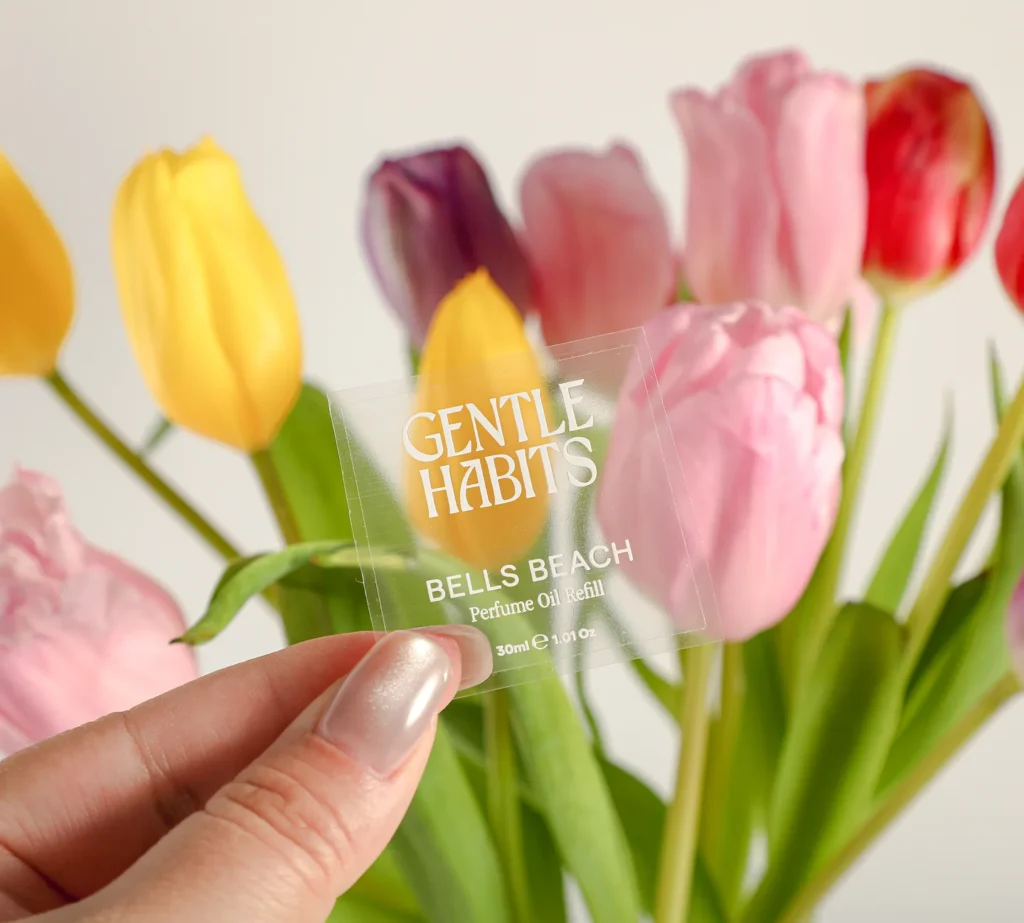
Why can a clear label turn cloudy in water?
A label may stay attached yet lose its transparent appearance. In a technical paper hosted by the Pressure Sensitive Tape Council, BASF authors Steven Gaik and David Schulenberg describe water whitening, also called blushing, as loss of adhesive clarity in moisture. Their examples include clear labels on shampoo bottles and glass beverage bottles. They also caution that clarity performance does not necessarily track peel or tack performance after immersion. Read the technical paper, section 3.3.
For a transparent label, therefore, approve appearance and adhesion separately. Photograph the same area before exposure, while wet and after drying. Include a dry comparison sample in the photographs and keep lighting consistent. A sample that clears after drying may still be unacceptable if customers see the bottle while it is wet.
Also distinguish adhesive cloudiness from intentional opaque printing. Our clear-label white-ink guide explains how white ink changes which areas should remain transparent.
Is applying a label to a wet bottle the same as using it in water?
No. Record the condition when the label is applied separately from the conditions after application. A bottle labeled before refrigeration presents a different process from a bottle taken cold and wet from a filling line.
For its specific CleanFlake PET constructions, Avery Dennison’s technical guidance calls for removing overspill or condensation before label application. Do not read a later wet-use claim as permission to apply that construction over condensation.
Tell your supplier the bottle temperature, surface condition and time between labeling and first water exposure. If your line cannot provide a dry surface, make that a selection requirement at the start. For chilled products, use our refrigerated-product label guide alongside this comparison.
How should you compare samples before ordering?
Use a written evaluation brief with your actual containers and proposed production labels. The table below is a recording template, not a standardized laboratory method. Agree the exposure sequence and acceptance criteria with the supplier before comparing results.
| Record | Specify before evaluation | Keep as evidence |
|---|---|---|
| Sample identity | Container, label construction and artwork revision | Sample IDs and dated photographs |
| Application | Surface condition, temperature and application method | Photos immediately after labeling |
| Time before exposure | The available interval in your production process | Actual elapsed time |
| Wet exposure | Splash, condensation or immersion; temperature and duration | Exposure log for each sample |
| Handling | Wet rubbing, squeezing or product contact relevant to use | Observations under the same sequence |
| Acceptance | Allowed edge lift, print damage and appearance change | Results against each agreed criterion |
Inspect the samples while wet as well as after drying. Keep observations separate: “still attached,” “readable” and “clear” answer different questions. Where a barcode matters, include its readability in the evaluation; do not assume that an intact label means the printed symbol remains usable.
Use consistent conditions across candidates and include repeat samples. One attractive photograph cannot show repeatability. If a supplier provides test results, ask whether they cover the same print, adhesive, container and exposure as your proposed order.
What should a useful quote request look like?
Here is an illustrative buyer brief, not a customer case or a claim that a label has passed testing:
We need clear labels for a PET body-wash bottle. Labels will be applied to dry bottles before packing. Customers will use the bottles in showers and handle them while wet. Please propose a printed construction and evaluation plan covering print wear, edge lift and clear-area appearance. We will provide the bottle, artwork and expected use conditions for sample approval.
Add the label dimensions, order quantity, number of designs and destination. If machine application is involved, include the roll specification and unwind direction. If size is undecided, follow our bottle label measurement guide before requesting the final quote.
MEIKEI accepts label enquiries from 100 individual labels. Share your container and wet-use requirements when requesting custom roll labels; the material, finish and suitability need to be confirmed for the proposed construction. Send your specifications and artwork for a quote.
Frequently asked questions
Are all BOPP labels waterproof?
The name BOPP identifies the face film. It does not establish how the printed image, protective finish or adhesive performs. Request evidence for the complete label on your container under the intended exposure.
Does a laminate make any label waterproof?
A laminate is one part of the specification. Check the printed surface, label edges and attachment after exposure rather than accepting the presence of laminate as proof of complete-label performance.
Can a waterproof label still fail a shower-product evaluation?
Yes, if its supported conditions do not match the use. Ask separately about repeated handling, contact with the packaged product and the appearance of clear areas. Record which requirement failed so the next sample addresses it.