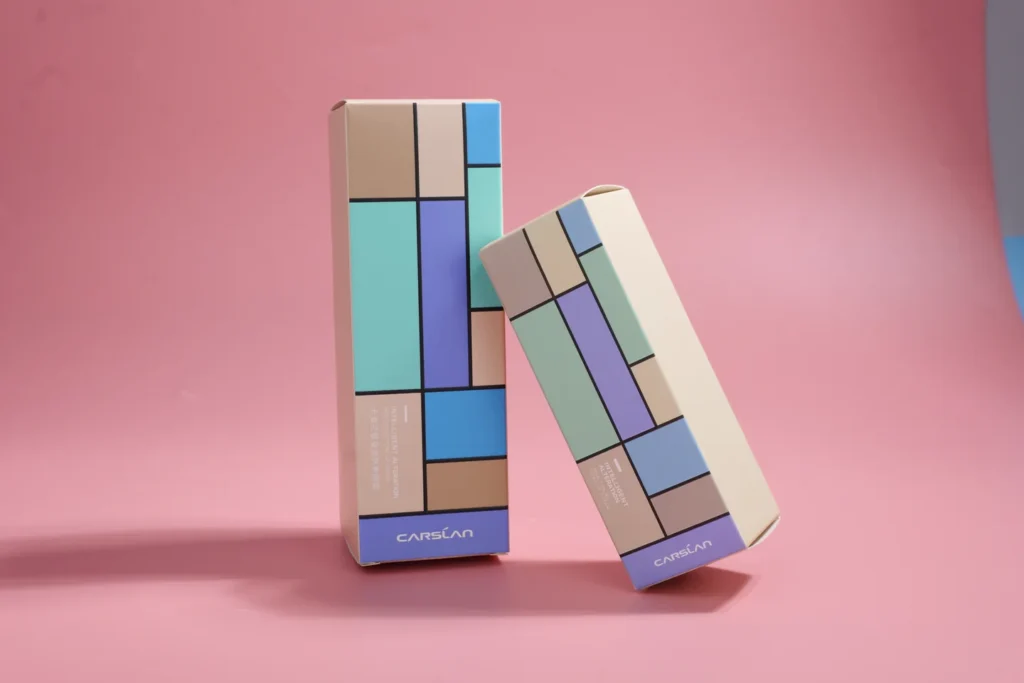
A useful cosmetic-box enquiry starts with the finished bottle, jar or tube—not just its nominal capacity and a reference image. The carton must fit the container with its closure, support the intended packing process and provide enough usable space for the approved artwork.
For a skincare brand, the expensive mistake is often approving those decisions separately: the bottle changes after the carton size is fixed, the pump needs more height, or a new language version no longer fits the approved panels. This guide shows how to prepare one coordinated brief for custom folding cartons before asking suppliers to price it.
Key takeaways
– Supply the assembled container dimensions and drawings, including its cap, pump or dropper.
– Separate fit, product restraint, artwork and shipping requirements in the brief.
– Approve the real filled pack before judging decoration alone.
– Compare quotations using the same component list and quantities.
Why isn’t “a box for a 30 ml bottle” enough?
Capacity describes how much the container holds, not its external shape. Two containers with the same stated fill volume can require different cartons, and adding a closure changes the assembly that must fit inside.
Gerresheimer’s cosmetic packaging catalogue presents different bottle and jar designs with technical specifications. It is an example of the type of container information to obtain from your primary-packaging supplier before developing the outer box.
Request a current drawing and a physical sample of the assembled pack. Include decorative labels, tamper bands or accessories that change the outside envelope. Identify whether the quoted dimensions describe the bare container, the capped container or the complete product as it will be packed.
Use our folding carton measurement guide for the dimension convention. Do not add an arbitrary clearance to a bottle drawing and treat that as the final box specification.
What should the carton hold in position?
Decide which movements are acceptable and which would damage the product or presentation. A single jar, a pump bottle and a multi-item set need different conversations about restraint.
For a pump bottle, identify whether pressure from the closed carton could act on the pump. For a glass container, identify where support is intended and whether decorative surfaces can rub against the interior. For a set, list every component and how it should face when opened.
These are design questions, not proof that an insert is always required. Ask for the simplest construction that meets the brief, then check it with the actual product. Pro Carton’s carton-design guidance treats product protection, packing, distribution and use as connected design requirements. A visually attractive empty carton answers only part of that brief.
How do you separate retail packaging from delivery protection?
State whether the carton will be displayed on a shelf, packed into a retail master case, or sent to individual customers inside a parcel shipper. The same decoration can be used across those channels, but the complete packing arrangement needs to be considered for each.
A retail folding carton should not be assumed to protect a glass bottle in the parcel network by itself. Show the supplier the intended outer shipper and any cushioning or dividers. If a fulfilment partner packs the orders, involve that partner before final approval.
Ask who is responsible for evaluating the complete shipping pack and what evidence is needed. Avoid turning an informal shake or drop demonstration into a claimed shipping certification.
Which artwork information must be fixed early?
Prepare a controlled copy file for each SKU and destination before squeezing text into a decorative layout. The designer needs to know the approved wording, language versions, identifiers and variable fields that must fit.
Use this matrix to prevent several teams from working from different assumptions:
| Information owner | What to provide | What must be resolved before approval |
|---|---|---|
| Product team | Final product name, variant and container configuration | Artwork matches the actual SKU |
| Brand team | Logo files, colour references and finish priorities | The same mark is not interpreted differently across files |
| Market or regulatory reviewer | Approved market-specific copy | Required content and language versions fit legibly |
| Barcode owner | Correct code artwork and identification | Code belongs to the intended SKU and remains readable |
| Packing team | Batch or other variable-marking requirements | The marking location and surface are compatible with the process |
| Procurement | Component quantities and destination | Quote, artwork and packing brief refer to the same order |
This is a production coordination checklist, not a statement of the legal text required in every country. Have the person responsible for your target market approve the final copy before printing.
For file preparation, use the packaging artwork checklist, and retain a version number on the approved artwork rather than relying on filenames such as “final-new.”
How should you specify the visual finish?
Describe the visual result and identify which feature matters most. “A matte carton with a small metallic logo” is a better starting point than selecting several finishes without a hierarchy.
Send a physical reference if colour, touch or sheen is critical. Separate the reference features: one sample may define the colour, another the foil appearance, and another the feel. Ask which combination is feasible on the proposed board and which sample will demonstrate it.
Do not judge a metallic effect or tactile finish solely from a screen proof. A rendered highlight is an illustration, not evidence of the manufactured effect. If a finish crosses a fold, seam or barcode area, flag it for production review instead of treating it as decoration independent of the structure.
What should a first enquiry contain?
The following illustrative specification shows the level of detail that makes a quotation useful. It is not a real order, a tested carton design or a price offer.
| Field | Example brief |
|---|---|
| Product | One skincare bottle with a fitted pump and overcap |
| Container evidence | Supplier drawing plus an assembled physical sample |
| Quantity | 1,000 finished cartons; variant split supplied separately |
| Structure | Supplier to propose an enclosed carton and any necessary support |
| Packing | Manual loading; product front should face the carton front |
| Brand artwork and approved English copy supplied separately | |
| Finish | Matte surface and one metallic logo area, subject to sample review |
| Sales route | Retail carton inside an outer e-commerce shipping pack |
| Approval evidence | Structural fit sample followed by agreed printed/finished sample |
Avoid supplying only “premium box, lowest price.” That leaves differences in structure, material and finishing hidden inside competing quotes.
What should be checked on the final sample?
Evaluate the packed product first, then the print. Confirm that the container loads without unintended pressure, the closure works, components remain in the intended position and the contents can be removed as planned.
Next compare the artwork to the approved copy. Check the variant, code, colour references, finishing position and any variable-marking space. Finally, confirm the agreed delivery condition: flat or erected, with separate inserts or other components clearly identified.
Record the approved sample and file versions using the packaging sample approval checklist. A later change to the bottle, cap, pump or artwork should trigger a review of the affected packaging decisions.
MEIKEI accepts folding carton enquiries from 100 finished cartons. Send your cosmetic-box brief with the assembled container details, quantity and target market. The next useful step is a defined construction and sample plan, followed by a quotation based on that specification.