Hot foil stamping transfers a metallic finish with a heated tool and pressure. Conventional cold foiling transfers it onto a printed adhesive pattern. For a label buyer, the useful comparison is the result on the chosen stock: clean detail, the right metallic colour, an acceptable surface feel and a repeatable price.
A gold logo on a textured wine label and a metallic colour panel on a smooth cosmetic label present different production questions. Specify the appearance you need, then ask the converter to confirm the process and sample. A photograph of a shiny label cannot reliably identify how its foil was applied.
What is the difference between hot foil and cold foil?
Hot stamping uses a heated tool to transfer the decoration, as explained in API Transfer Technologies’ hot-stamping overview. Conventional cold foiling uses a printed adhesive image instead of a hot-stamping die. See ITW ShineMark’s cold foil guidance.
| Specification question | Hot foil stamping | Conventional cold foiling |
|---|---|---|
| How is the image transferred? | Heat and pressure through a stamping tool | Adhesive printed in the image area |
| What should the quotation identify? | Tooling, foil grade and stamping operation | Plate, adhesive, foil grade and press sequence |
| Is the metallic image automatically raised? | No; request embossing separately | No; a raised effect needs an additional process |
| What should the sample establish? | Coverage, detail and any unwanted impression | Coverage, adhesion and compatibility with overprinted ink |
| What decides the buying choice? | Approved appearance and total job cost | Approved appearance and total job cost |
Use this table to compare quotations. It is not a specification for press temperature, pressure or adhesive cure; those settings belong to the selected materials and equipment.
Which option suits textured paper labels?
Start with a physical sample of the exact paper. ITW recommends smooth, coated surfaces for predictable conventional cold-foil results and identifies absorbent substrates as more difficult. That is a reason to test a textured stock, rather than reject every cold-transfer process or assume every hot foil will work.
Foil grades also differ. API Transfer Technologies separates textured graphical applications within its hot-stamping product range. Ask the converter to name the proposed grade and show it on your paper, not just on a smooth demonstration card.
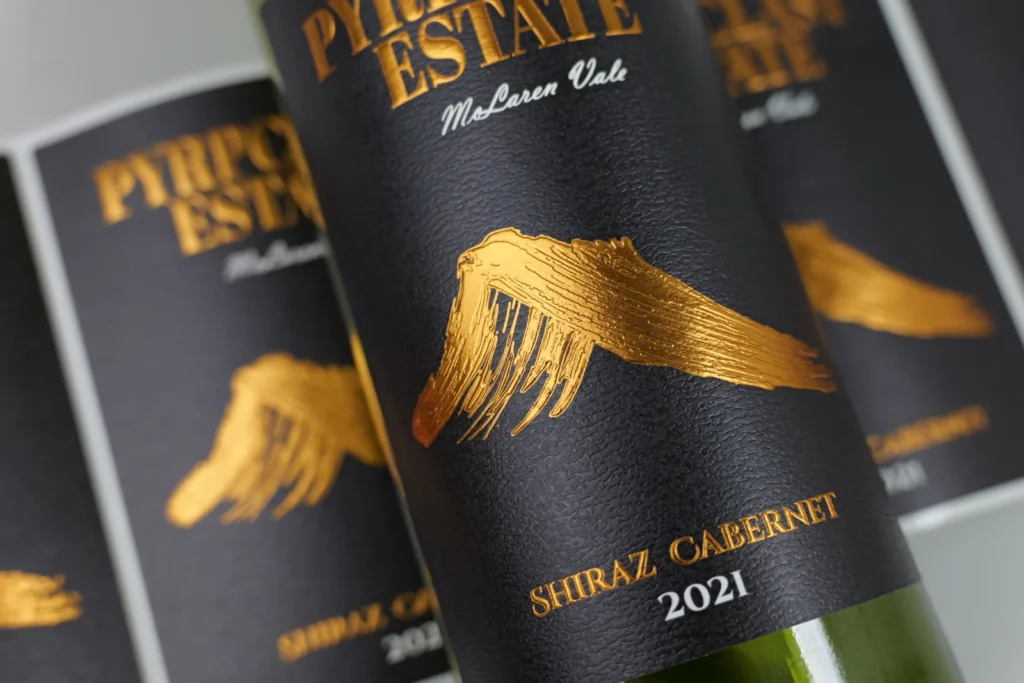
For the black label photographed above, the useful visible features are the reflective wing, narrow lettering and textured background. The image comes from MEIKEI’s company photo library; it is a finish reference, not a documented hot-versus-cold production trial.
Mark three areas on your own artwork for sample inspection: the smallest letter, the narrowest open gap and the largest metallic solid. Inspect these same areas in every proposed sample. For stock selection, see our textured paper label guide.
Can cold foil produce coloured metallic labels?
Suitable cold-transfer systems support ink overprinting, but compatibility is grade-specific. For example, API’s CTWD specification describes a narrow-web transfer product intended for applications including self-adhesive labels where overprintability matters. It lists compatible UV inks, coatings and adhesive systems. That evidence supports a particular material combination, not a promise that any ink will adhere to any metallic foil.
When asking for a metallic blue, green or rose-gold effect, send a physical colour reference if available. Ask whether the proposed result uses a coloured foil or ink over a metallic base. Keep that construction in the approved specification so a repeat order follows the same route.
Judge the completed sample with its final varnish or laminate. Approving a bare metallic swatch leaves the appearance of the finished label unresolved.
Does hot foil automatically create an embossed label?
No. Metallic decoration and raised relief are separate requirements. Write both into the brief if you want a logo that looks metallic and feels raised. Ask the converter to identify the embossing operation in the quotation.
Name the exact areas that need relief: the logo, lettering, border or background pattern. A request for an “embossed gold label” without a marked artwork layer can leave the supplier guessing which parts should be raised.
Compare a flat foil sample and a foil-plus-emboss sample under the same light, then touch them. Our emboss versus deboss guide explains the relief choice separately from the metallic colour.
Is cold foil cheaper than hot foil?
There is no reliable price winner without the job specification. ITW notes that small, local foil areas can favour hot stamping economically, while broader coverage can favour cold foil. Your actual quote also needs quantity, number of designs, material, tooling, finishing and delivery terms.
Here is an illustrative artwork calculation, not a customer order or a foil-consumption estimate:
| Example on a 90 × 60 mm rectangular label | Metallic image area | Share of the label face |
|---|---|---|
| A 20 × 15 mm rectangular logo | 300 mm² | 5.6% |
| A 60 × 40 mm rectangular panel | 2,400 mm² | 44.4% |
The label face is 5,400 mm². Each percentage is image area divided by face area, multiplied by 100. These designs create different estimating questions, but eight times the image area does not establish eight times the foil cost. Web layout, foil travel, repeats and setup must be priced by the converter.
Request comparable prices at the quantities you actually intend to buy. Separate one-time tooling from repeat-order charges, and ask what changes if the artwork or foil colour changes. Avoid comparing a hot-foil quote with embossing against a cold-foil quote without it.
What should you check before approving a foil label?
Approve a sample on the specified label stock, attached to the intended container where practical. A useful inspection record covers:
- Image coverage: inspect metallic solids for unwanted gaps and compare fine lettering with the artwork.
- Registration: check where foil meets print, borders or an embossed feature.
- Surface appearance: inspect the finished coating, colour and reflectivity under consistent lighting.
- Handling: agree on a rub or handling check that reflects the product’s actual use, with a documented acceptance standard.
- Label application: confirm the adhesive, container surface and service conditions independently of the decorative finish.
Do not infer waterproofness or refrigeration suitability from the presence of foil. A metallic face does not establish how the entire label construction behaves on a cold, damp bottle. If that is your application, include the requirements in the brief and consult our refrigerated-product label guide.
What should you send for a foil-label quotation?
Send the label dimensions, quantity, number of designs, container material, proposed stock and artwork with the foil areas clearly marked. Add the required metallic colour, any raised or recessed areas, and whether the labels will be applied by hand or machine.
Planning custom foil labels? MEIKEI’s label MOQ starts at 100 labels. Share your artwork, quantity and intended finish so we can review the available material and production options. The chosen foil process, tooling and final price are confirmed for the job. Send your label brief or explore custom roll labels.
Frequently asked questions
Can you identify hot foil or cold foil from a photograph?
Usually not with confidence. Reflection, texture, lighting and image processing can conceal the differences. Ask for the production specification and a physical sample.
Should a short run always use hot foil?
No. Ask for a quote for the actual design and quantity. A blanket minimum run length does not account for tooling already available, finishing operations or the converter’s equipment.
Can a supplier substitute one foil process on a repeat order?
If you approved a particular construction, request a new sample before accepting a process or material substitution. Keep the approved artwork, foil reference and finishing specification together with the order record.