A tamper-evident label is intended to make specified interference visible. It does not make a package impossible to open, guarantee the contents are safe or independently prove authenticity. The first purchasing question is therefore not “Which security sticker looks best?” It is “Which opening must show evidence, on which surface, and when will someone inspect it?”
Start with the closure: Identify the access route, choose a visible failure mechanism and test the finished seal on the actual pack. A strong adhesive is not enough if the pack can open somewhere else or the evidence is difficult to recognize.
This guide covers a practical specification and sample review for labels bridging lids, caps, carton flaps and other package openings. Product-specific regulatory requirements need a separate review; a generic seal is not a compliance certificate.
Which evidence mechanism suits the package?
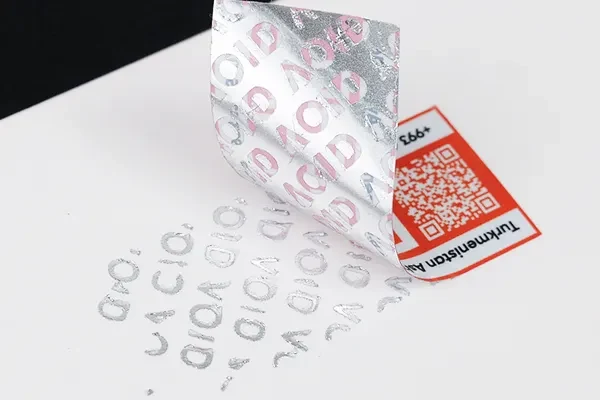
Three common approaches are destructible face stock, a revealed VOID or pattern, and a seal designed to tear at the opening. They should be evaluated by the evidence left after interference, not by the label’s appearance before opening.
For example, 3M documents both materials that fracture during removal and constructions that reveal a VOID or triangular pattern. These are distinct material behaviors, not interchangeable names for a permanent label. 3M tamper-evident material overview
| Candidate approach | Evidence to look for | What the sample must establish |
|---|---|---|
| Destructible face stock | Irreversible fragmentation or damage when removal is attempted | It does not lift away intact from the actual surface |
| VOID or pattern-reveal construction | A recognizable changed pattern on the label, surface or both, as specified | The pattern activates and remains visible on the selected pack |
| Tear seal across a closure | A broken or visibly damaged bridge across the opening | Normal opening cannot bypass the bridge without evidence |
| Non-residue tamper-evident construction | A lasting change in the label with the specified surface condition | The evidence remains clear while the surface meets the agreed cleanup requirement |
The last option is not simply a removable label. TamperTech describes non-residue constructions that reveal a change in the label while leaving the surface clean. Define which part must change and whether residue is acceptable. Avoid requesting “no trace” and “visible tamper evidence” without explaining where the evidence should remain. TamperTech seal-construction guide
Map the opening before choosing the label shape
Use an assembled pack and mark every ordinary route to the product. For a folding carton, this may include both ends; sealing only the displayed top flap can leave another opening unchecked. For a screw cap, inspect the relative movement between cap and container. A label placed entirely on the lid may decorate it without bridging the opening.
Ask the designer to show the label’s contact area on both sides of the closure, the unbonded span across any gap and the intended tear or reveal location. Check that required product information and operating instructions remain readable.
For a hypothetical jar, a strip crossing from the lid to the body might be a candidate. It still needs testing on that lid coating, body surface and closure geometry. The sketch alone does not demonstrate performance.
Specify the surface as carefully as the seal
“Plastic bottle” is not a complete application description. Record the resin or available material specification, surface texture, coatings, cleanliness and the temperature when the label is applied. Include oil, powder, condensation or other contamination that may be present in the real packing process.
Avery Dennison’s technical bulletin explains that tamper-evident polyester behavior depends on bond development and application conditions, including surface composition, texture and cleanliness. It recommends testing in the intended application. The bulletin is dated 2007; use it for the underlying principle, and request a current data sheet for the material being quoted. Avery Dennison tamper-evident polyester bulletin
For coated cartons, test the finished printed board, not an uncoated offcut. For chilled packs, reproduce application and storage conditions separately. Our refrigerated-product label guide explains why the temperature during application and the later service environment should both appear in a brief.
Test the seal at the earliest realistic opening time
A seal that works after prolonged storage may behave differently immediately after packing. Ask the material supplier for its recommended bond-development conditions, then add the earliest point at which the pack could be handled or opened in your operation.
Build a sample plan around real events: immediately after the permitted production dwell, after warehouse storage and after any relevant transport or temperature exposure. Do not adopt one universal waiting time for every adhesive and surface.
Label each sample with its construction, application time and conditions. Photograph the intact seal, the attempted opening and the resulting evidence. Keep the original samples where useful; photographs can miss subtle pattern changes or lifted edges.
Use a pass-or-rework checklist that describes evidence
The following is a proposed purchasing checklist, not a standardized security test. Agree the exact attempts, conditions and acceptance criteria with the supplier and your quality team before approval.
- Normal opening: Does opening the designated closure produce the agreed visible change?
- Removal attempt: Can the label be lifted and replaced without the specified evidence?
- Alternative opening: Can an unsealed flap or another normal access route bypass the label?
- Handling control: Do otherwise intact packs remain clearly distinguishable after ordinary packing and transport handling?
- Visibility: Can the intended inspector identify the changed seal under the expected lighting?
- Information: Are batch details, expiry markings and essential instructions still usable?
- Traceability: Can each tested specimen be connected to its material, artwork and application record?
Record a specific observation rather than a vague “pass.” For instance, “seal lifted intact from coated flap” identifies a problem to investigate; “adhesive bad” does not. Our sample approval checklist provides a broader structure for retaining the agreed packaging reference.
Why can a permanent label still be the wrong choice?
Permanent describes an intended adhesion behavior; it does not, by itself, describe a reliable tamper indicator. A seal needs a clear evidence mechanism and appropriate placement. Conversely, damage to a poorly applied label during normal handling can create confusing false indications.
Resolve that ambiguity by keeping unopened handling-control samples beside opened samples. Ask the reviewer to classify them using the intended inspection instructions. If the distinction is unclear, revisit construction, placement or the visible message before production.
The permanent versus removable adhesive guide covers adhesion selection separately. Neither adhesive category substitutes for an opening-evidence specification.
What to include in a seal-label enquiry
Provide an actual pack if possible, plus photographs showing the closed and open positions. State the product category, destination market, application method, quantities, expected storage conditions and whether residue is acceptable. Mark the closure that must show interference and any additional opening routes.
Ask the supplier to identify the proposed face stock, adhesive, evidence behavior and current supporting documentation. Treat printing, material suitability and the package’s legal obligations as separate questions that all need resolution.
For custom labels and stickers, send a specification enquiry with those details so material availability and a suitable sampling route can be checked. Approve an observed result on your pack before treating the seal as ready for production.