SBS and FBB are paperboard families used for folding cartons. SBS means solid bleached sulfate; FBB means folding boxboard. Choosing between them requires the actual board grade, thickness, stiffness, surface finish and carton design. A label such as “350 gsm white board” does not identify all those properties.
For a cosmetics or personal-care carton, start with the product you need to pack and the appearance you want inside and outside. Then compare specified grades in a folded sample. This guide explains the material terminology and the evidence to request before approving a substitution.
What is SBS paperboard?
SBS is made from bleached virgin fibre and provides a white surface for printed packaging. Smurfit Westrock’s SBS overview describes this material family and its printing applications.
European specifications also use SBB, meaning solid bleached board. Holmen describes its SBB construction as layers of bleached chemical pulp, with coatings that depend on the product. Treat SBS or SBB as a family description; obtain the mill and grade name before comparing two quotations. See Holmen’s technical terminology.
For a carton with printing inside, specify the reverse-side print requirement explicitly. A white reverse does not by itself establish the same surface treatment or print result as the front.
What is FBB paperboard?
FBB uses different pulp layers to build the board. Metsä Board’s explanation of folding boxboard describes bleached chemical pulp at the surfaces and a bulky middle layer made using bleached chemi-thermomechanical pulp. Exact construction varies by grade and manufacturer.
You may also encounter GC1 and GC2 in a specification. Holmen distinguishes white-back FBB, GC1, from cream-back FBB, GC2. That difference matters when customers see the carton interior or when your artwork includes inside printing. It does not mean one abbreviation alone establishes the finished carton’s quality.
Ask for an unprinted sheet sample as well as the printed carton. Open the flaps and inspect the reverse under the same lighting as your approved reference.
SBS vs FBB: what belongs in the comparison?
| Buying requirement | What to ask for in an SBS quote | What to ask for in an FBB quote |
|---|---|---|
| Fibre construction | Bleached chemical-pulp construction | Mechanical or BCTMP middle layer with chemical-pulp surfaces; confirm the grade |
| Material identity | Mill, grade and current technical sheet | Mill, grade and current technical sheet; GC1 or GC2 where applicable |
| Inside appearance | Reverse-side colour and coating | Reverse-side colour and coating, rather than “white board” alone |
| Carton rigidity | Thickness and stiffness data in both directions | Thickness and stiffness data in both directions |
| Printing and finishing | A sample with the intended inks, coating and decoration | A sample with the intended inks, coating and decoration |
| Folding and closure | A die-cut sample of the actual structure | A die-cut sample of the actual structure |
| Price comparison | Finished-carton price for an agreed specification | Finished-carton price for an agreed specification |
This is a quotation framework, not a claim that one material is always stiffer, cheaper or more premium. Compare the two proposed products, rather than every board sold under their family names.
Does the same GSM mean the same thickness?
No. GSM measures mass per area; thickness measures the distance between the board surfaces. Do not substitute one for the other when checking product fit, crease settings or flap closure.
The following values come from the published MetsäBoard Classic FBB product sheet. They illustrate one specific grade, not a universal conversion chart:
| Published property | 250 g/m² option | 275 g/m² option |
|---|---|---|
| Thickness, ISO 534 | 450 µm / 0.450 mm | 500 µm / 0.500 mm |
| Bending stiffness, MD, Taber 15° | 19.2 mNm | 25.2 mNm |
| Bending stiffness, CD, Taber 15° | 9.7 mNm | 12.6 mNm |
Source: MetsäBoard Classic FBB product sheet, issued July 2, 2020; the retrieved copy carries an August 19, 2026 print date. It identifies the stiffness method as ISO 2493-2 and specifies test conditions of 23°C and 50% relative humidity. Obtain the current supplier specification for your purchase.
The numbers do not tell you how an unspecified SBS grade would compare. Request its sheet before drawing that conclusion. They also do not establish a safe packed-product weight: carton geometry and the complete pack still need evaluation.
For more detail on purchasing units, use our paperboard thickness and GSM checklist.
How should you compare carton stiffness?
Request values measured by the same method, angle and direction. MD means machine direction; CD means cross direction. A single stiffness figure without these identifiers is difficult to compare fairly.
In your sample review, keep the structure and packed product consistent. Place the same bottle or jar in each carton, close the same flaps and examine the same panels. Record whether you are comparing a material-only change or a different dieline as well.
A thinner panel may look acceptable flat yet behave differently after folding. Approve the assembled carton and its fit rather than relying only on how a flat sheet feels in your hand. Our grain-direction guide covers the relationship between board orientation and creasing.
Which board should you choose for a cosmetic carton?
Use the design requirements to narrow the candidates. For a dark, full-coverage exterior, inspect the printed surface and folded edges. For an unprinted light interior, compare actual reverse colours. For foil or embossing, approve the decorated sample on the proposed board.
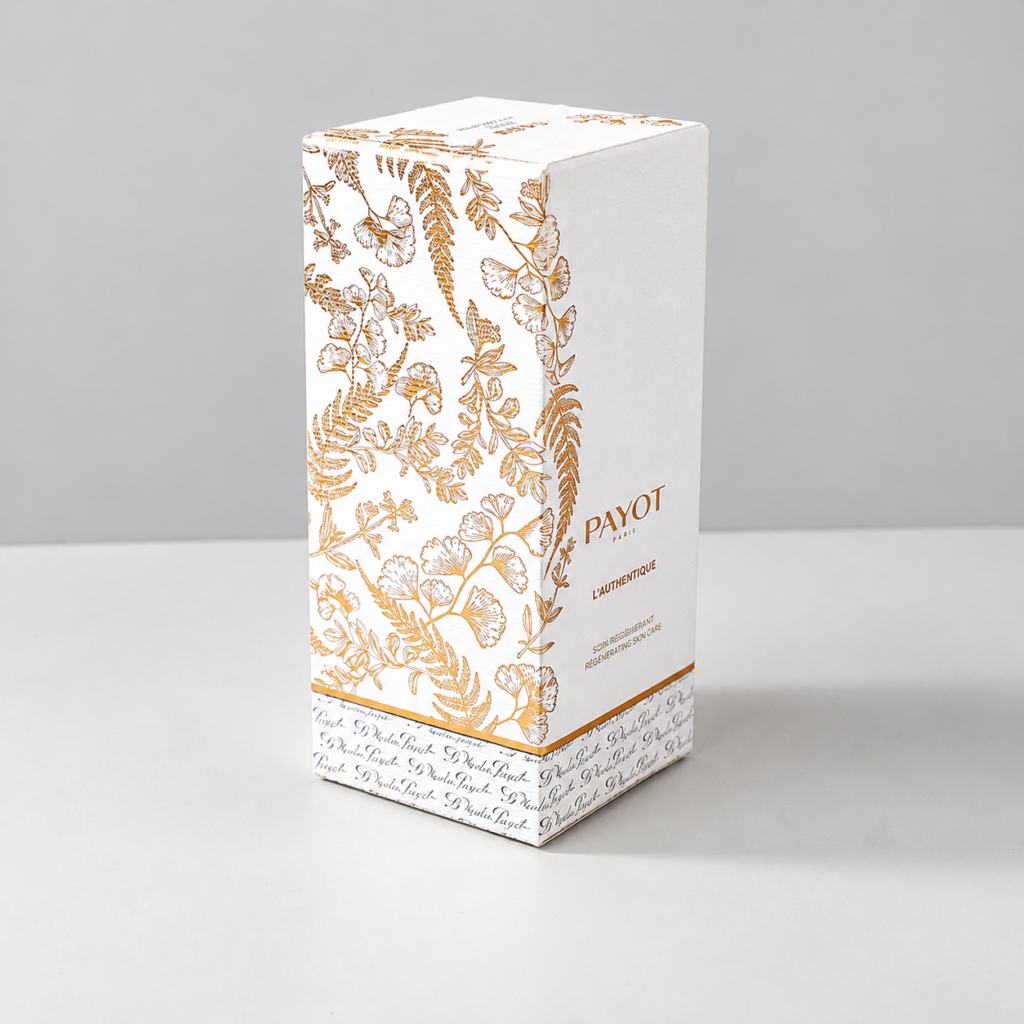
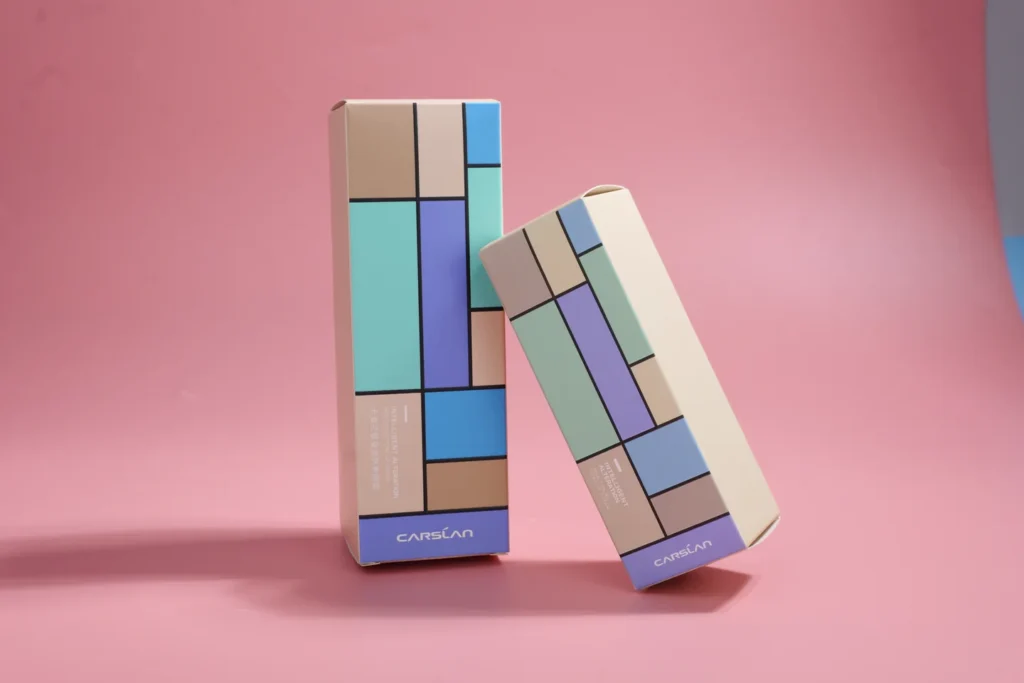
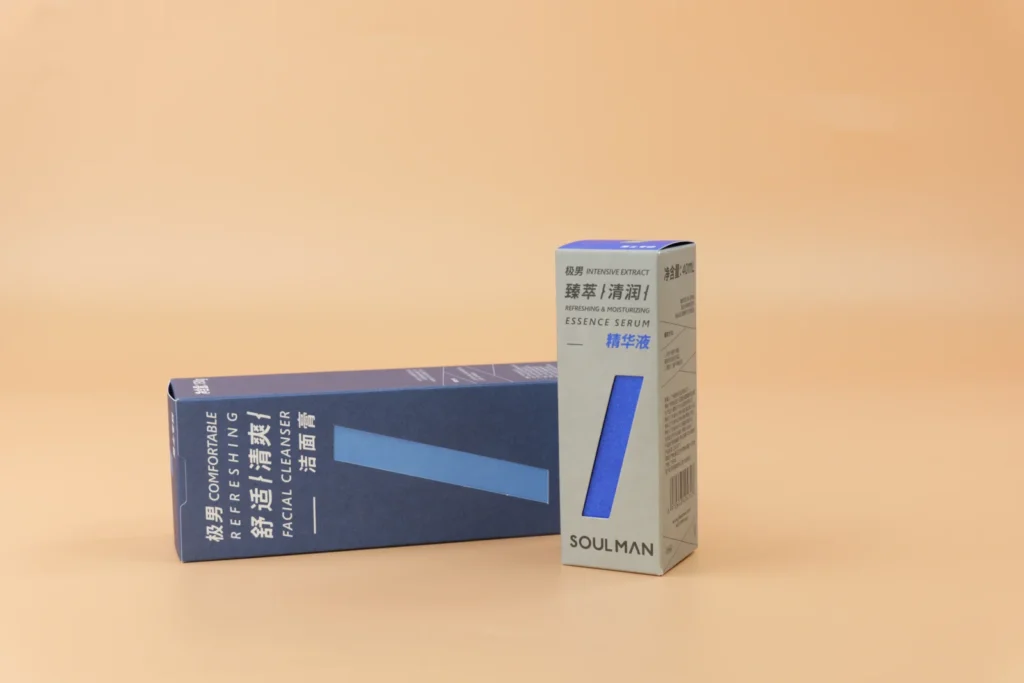
The photograph above shows two printed folding-carton samples from MEIKEI’s company library. It illustrates finished panels and carton format. A photograph cannot identify whether the board is SBS, FBB or a particular mill grade.
Consider a hypothetical brief for a 50 ml serum bottle: a printed outer carton, an insert, a visible light interior and metallic decoration. The bottle capacity does not determine the required board thickness. Provide the bottle dimensions and weight, then review fit, closure, decoration and the chosen insert together. This is a specification example, not a claimed customer project.
Is FBB cheaper than SBS?
Ask for the total delivered quotation for the same quantity and performance requirements. A material price by weight does not resolve the cost of a finished carton, and a lower-GSM alternative is useful only if the approved pack still works.
Have the quotation separate the carton, insert, printing, finishing, tooling and delivery where applicable. If an alternative grade is proposed, record what changed: thickness, reverse colour, surface coating, stiffness or supply specification. That makes the saving and the compromise reviewable.
Avoid accepting “equivalent white board” as the entire substitution description. Retain a sample and the agreed material name with the purchase record so repeat orders can be checked against them.
What information produces a useful paperboard quotation?
Provide the product’s dimensions and weight, desired inside carton dimensions, quantity, number of designs, artwork and finishing requirements. Include any insert and explain whether the product touches the board directly. For specialised uses, ask for the documentation applicable to the specified grade and finished construction.
If you have an existing carton, send a sample and identify which features must stay consistent. If you do not have a material preference, ask the converter to propose named alternatives with a clear reason for each.
Planning custom folding cartons? MEIKEI’s MOQ starts at 100 cartons. Send your product dimensions, quantity and artwork for a material and structure review. The proposed board, finishing and price are confirmed for your specification. Explore custom folding cartons or send your packaging brief.
Frequently asked questions
Is FBB recycled paperboard?
FBB does not mean recycled-content board. The designation describes a board family; Metsä Board’s cited construction uses fresh-fibre pulp layers. Ask for the actual grade’s fibre and certification information instead of inferring it from the abbreviation.
Can I replace SBS with FBB at the same GSM?
Only after evaluating the specified alternative. Confirm thickness, surface and reverse appearance, stiffness data and the folded sample. Equal mass per area does not establish an identical carton.
Which paperboard is best for a heavy product?
Neither family name supplies a load rating. Share the packed weight, structure, insert and distribution requirements, then agree how the complete pack will be evaluated. Select the material on that evidence.